Chiyo · Sayuri
Memoirs of a GeishaChiyo / Sayuri’s transformation from a village child into a novice geisha begins under conditions she does not control: she is trapped by her obligations to the okiya, injured after a failed escape, and later informed that both parents have died. Her emergence as Sayuri is therefore not a simple change of name or fortune. It is a passage into a possible future that also makes her feel that the child she was has been destroyed.
Identity and Early Circumstances
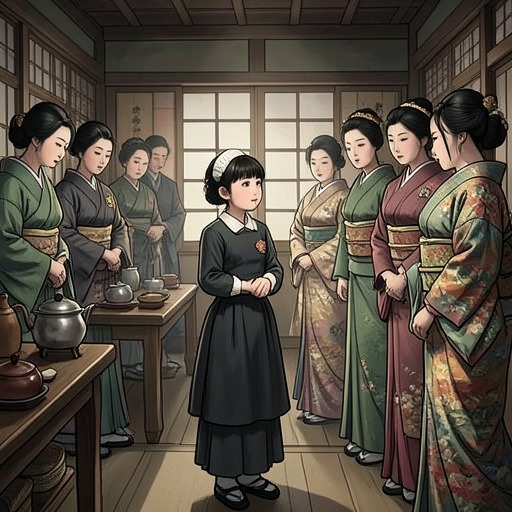
As Chiyo, she is a young maid in the Nitta okiya, where she fears getting into trouble with Mother and tries to appease Hatsumomo by offering to do whatever she wants. Her explanation that she had gone out to deliver Hatsumomo’s shamisen does not free her from Hatsumomo’s accusations or power. The exchange establishes how little control Chiyo has over her movements: even her attempt to meet an obligation becomes grounds for intimidation.
Her escape attempt ends in physical injury. After she lands in the courtyard, Chiyo has broken her arm; a doctor takes her to a nearby clinic the next morning, and she returns to the okiya in the late afternoon with a plaster cast, still in terrible pain. Mother summons her immediately. The injury is at once a bodily consequence of the failed flight and a circumstance in which Chiyo must face the woman who controls her place in the household. The passage gives the injury practical weight—medical treatment, a clinic visit, and a cast—rather than treating it only as a symbol of misfortune.
Loss and the Interrupted Past
Chiyo receives news of her parents’ deaths in a letter written after she has left Yoroido. Six weeks after her departure, her mother’s suffering ended; her father died a few weeks later. Their remains are enshrined in the village cemetery, and services were held at Hoko-ji Temple in Senzuru, while women in Yoroido chanted sutras. The news confirms that the separation from her family has become irreversible: there is no return to the life from which she was taken.
The letter also reports that Satsu passed through Yoroido late in the fall and promptly ran away again with the son of Mr. Sugi. It asks Chiyo to notify Mr. Sugi if she hears from her sister, but offers no reunion between the sisters. Instead, it places Satsu’s continued flight beside the deaths of their parents, leaving Chiyo with knowledge of the family’s fate but no renewed closeness to the family itself.
Kindness and the Possibility of a Different Future
During an earlier encounter, the Chairman wipes grit and tears from Chiyo’s face and tips her head up. He tells her she is a beautiful girl with nothing to be ashamed of, and suggests that either someone has been cruel to her or life has been cruel. Chiyo answers that she does not know, although the narration makes clear that she understands the source of her fear. The moment draws a contrast between the humiliation and coercion surrounding her and an act of kindness that recognizes her distress without demanding that she explain it.
The Chairman’s words do not erase what has happened, but they give Chiyo a different way to be seen. He narrows his eyes as if urging her to think seriously about his remark that people find less kindness in the world than they should. This early encounter helps establish why the possibility of another life can matter to her: the first opening is not a rescue from her circumstances, but a brief recognition that those circumstances are not all she is.
Mameha’s Guidance and the New Name
When Chiyo visits Mameha, she enters an apartment carefully marked by elegance: new yellow-green tatami with silk borders, a calligraphy scroll, and blossoming dogwood branches arranged in a dark, cracked-glaze dish. Mameha appears in a cream kimono with a water design at the hem, then asks how Chiyo managed to leave her okiya that afternoon. The question shows that Mameha understands the constraints surrounding the girl, even as Chiyo struggles to answer. In this room, Chiyo is not simply an unseen servant: Mameha addresses her directly and creates the possibility of guidance.
That possibility takes institutional form in a ceremony at the Ichiriki Teahouse, attended by the mistress of the teahouse, Mother, and two of Mameha’s younger sisters. Chiyo and Mameha drink from three sake cups, taking three sips from each. The ceremony lasts about ten minutes, but its consequence is lasting: Chiyo is no longer known by her childhood name and becomes the novice geisha Sayuri. In the first month of apprenticeship, a novice cannot dance or entertain alone, but must accompany her older sister and spend much of her time watching and learning. The new identity is thus both a social status and a dependent stage of training.
Mameha has worked with her fortune-teller to choose the name. Its elements are explained through their meanings and the balance of personality: sa means together, yu comes from the zodiac sign for the Hen, and ri means understanding. Combinations incorporating an element of Mameha’s own name were judged inauspicious. The care spent selecting the name makes the transition deliberate, shaped by training and auspicious calculation rather than by a spontaneous personal choice.
Becoming Sayuri
The naming ceremony does not feel like uncomplicated celebration. Afterward, the assembled guests eat red rice mixed with red beans, but Chiyo picks at her food, unsettled. When the teahouse mistress calls her Sayuri, she understands what has been troubling her: it feels as though the barefoot girl who ran from the pond to her “Tipsy house” no longer exists. The name opens a new role, but in Chiyo’s experience it also marks a loss of continuity with her former self.
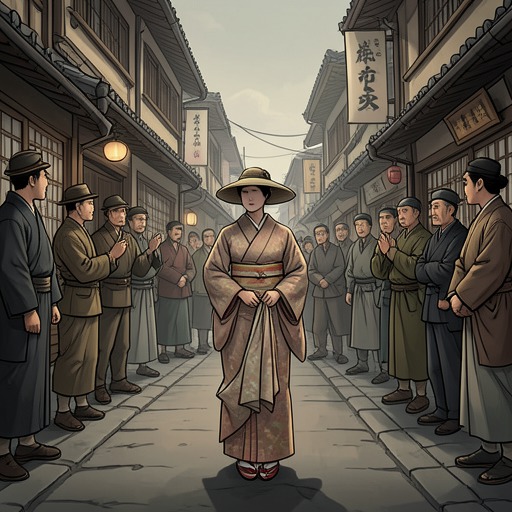
That tension gives her transformation its force. The apprenticeship offers a place in which she can watch, learn, and develop under Mameha’s guidance, while the formal renaming makes visible how thoroughly her life is being remade by others. Sayuri begins not as an identity entirely separate from Chiyo, but as the new person Chiyo must become—and as the name through which she mourns the child she fears she has left behind.